Monday, June 28, 2010 10:12pm CDT


62 degrees  Clear   Wind N4mph


What a spectacular evening!

After all of the heat and humidity and storms over the last week or so, we are now into a stretch of perfect weather.  Sunshine.  No humidity.  Bright blue skies.  Light breezes.  And tonight  a spectacular sunset.

Golds and reds and crimsons and purples.  And bright rays of sun shooting up into the sky from below the horizon.  And all of it reflected in the bright blue water of the lake.  These long days of summer give the extended times of twilight that are so magical.  And so practical.  They allow you to get caught up on lawn mowing until almost 10pm!

I wanted to update you on a couple things.

A couple days ago, the loons paid a visit and came swimming by.  They came in quite close to shore and near the nest which has been pulled into the shallows by the dock.  It was like they were just taking a drive through the old neighborhood to see where they had lived and what was happening with the neighbors.  They did not stay long but just long enough to show that they still remembered and had an interest in the area.

Most of the time I do not see much of them during the times I am home.  But an occasional glimpse here and there is always nice.  They look like they are in very good health and doing well.   A couple times I have seen them with other loons on the lake.  And it is always so special when you hear them calling at night.

They don't call near as much as when they are defending territory or when they have chicks, but the occasional call is still enough to stir the soul deeply!

So rest assured that they seem to be doing well.

Some of you have asked about seeing groups of loons together and wondered if this was normal.

If they are not defending nesting territory or if they do not have chicks, it is quite normal.  Typically these would be loons that have not mated or loons who do not have chicks for whatever reason.

As you know, loons stay down on the Gulf of Mexico for the first 2 or 3 years of their lives.  But even when they come back north, they usually will not mate until they are 5 or 6 or 7 years old.  So the groups of loons that you are seeing could be some of these loons that have not yet mated.

The other thing that I wanted to update you on is the loon with the 'bad leg' that Susan and her son rescued.

I talked with the good people at the Wildlife Rehabilitation Center of Minnesota this afternoon.

The loon seems to be doing well but has a long way to go yet.

X-rays did not show any broken bones, which is good.  They feel that the reason the leg is stretched out behind is either because of soft tissue damage or possibly nerve damage.  There is no way to tell at this point what caused the injury.

I was especially concerned when I heard the words "possible nerve damage".  But they assured me that nerves can and often do heal themselves and that it is not an automatic bad diagnosis.  So all they can do is watch and wait and take care of the loon while it hopefully heals and can be released back into the wild.

However, with loons time is the enemy.

Whereas many birds can survive and even thrive in captivity, loons do not do well in captivity at all.  And few survive.  Ask yourself, when is the last time you saw a loon at a zoo.  You probably never have because there are very few zoos that even attempt it because loons are almost impossible to keep in long term captivity.  They truly are birds of the wild and part of the reason that we so identify their calls with the great wilderness areas of the north.

The folks at the Wildlife Center have graciously told me that they will try to let me know of the loons progress so that I can pass the word on to you.

If you would like more information about the Center itself, you can find them at wrcmn.org

They treat thousands upon thousands of animals each year.  They are the second largest center like this in the US, second only to a center in California.  However, the California center also treats raptors, which the Wildlife Rehabilitation Center of Minnesota does not.  But we are also fortunate enough to have the Raptor Center [http://www.cvm.umn.edu/raptor/] here in Minnesota which is also a world-renowned center.  They told me that when you combine the figures of the Wildlife Rehab Center with those of the Raptor Center, no one else in the country comes close to the number of animals treated.

So we can thank the Wildlife Rehabilitation Center for all of their good work, including the x-rays that they did on our loon eggs a couple weeks ago!

They also got another loon in yesterday from Wisconsin!

You will remember that I told you how during rainstorms loons (and other waterbirds) can sometimes mistake highways and parking lots for bodies of water and land on them.  Ducks and other waterbirds can take off when they realize their mistake.  But a loon is trapped.  He cannot take off without a long body of open water.  And so he will die unless he is rescued.

Someone was kind enough to rescue this loon also and bring him to the Rehab Center.  They said he was in good shape except for some abrasions on the bottoms of his feet.  He will also be released when it seems safe to do so.  That release will probably before "Sue's Loon" is able to be released.

So that brings you up to date on both our loons and also the loon that was rescued.

I will try to let you know of any other information as I get it.

So until we talk again, I hope all of you have a wonderful and safe 4th of July!

And watch out for loons while you are out on the lake.
Monday, June 20, 2010 9:44pm CDT

69 degrees    Magic Twilight   Calm
 
Was last night amazing or what?!!
 
It was as if the loons really wanted to say 'Goodbye' to you!
 
They called over and over and over.  It is the most calling that I have heard since the night I took the egg off the nest and they called back and forth to another pair of loons before they even knew the egg was gone.
 
I could not believe how long and how often they called.
 
It was bittersweet for all of us for this adventure this year to come to an end.  Again let me tell you that I will periodically post an update for you.  They will probably be few and far between because without chicks the loons will be out and about more.  But I will try to update you once in a while.
 
Tonight I took in the swimming raft and the buoys and moved the nest closer to shore.  So now boats and fishermen do not have to worry about it.  I haven't taken the nest up to shore yet nor taken all the equipment apart.  But I will soon...I am gone for the next couple days so it will have to wait until after that.
 
It gave me a chance to have a closer look at the nest for the first time since I put it out over two months ago.  Can it really be that long ago?!
 
There are several of the willow branches near the camera and microphone wires that definitely had been gnawed.  You will remember that I was VERY concerned that the muskrat would gnaw through the cables and shut everything down.  There was no sign that he had gnawed on the wires but he definitely had gnawed on the branches!  And it was only an inch or two away from the cables....MUCH too close for comfort!
 
I also tried to see what he was so intent on eating night after night when the loon would reach out and poke him.  There was no creeping Charlie, green or dry, left in that area.  I still cannot believe that he was intent on eating creeping Charlie but it may be.  The other possibility is that I had put a cattail root over in that general area.  It seem more likely that that is what attracted him but I am not sure.
 
Also, the bowl of the nest was surprisingly shallow.  More shallow than what I have usually seen.  So it is no wonder she bumped the egg out of the nest twice.  And I have never seen that before.  I have to wonder what effect the MANIC nest-building played in that.  When she was just THROWING material up on the nest!  With the eggs already in the nest there was not the opportunity to use her feet to deepen the bowl like they would normally do.
 
Once again, behavior that I have not seen before.  I keep asking myself if this was a new and inexperienced pair of loons just learning everything for the first time.  She really had taken almost all the vegetation she could get loose from around the iris and daylilies.  They were left high and dry!  It is amazing that they even survived.  She had even gotten one small daylily bulb up INTO the nest where it was growing!
 
The side of the nest facing out to the lake was especially low and I think that contributed to the egg ending up in the lake.
 
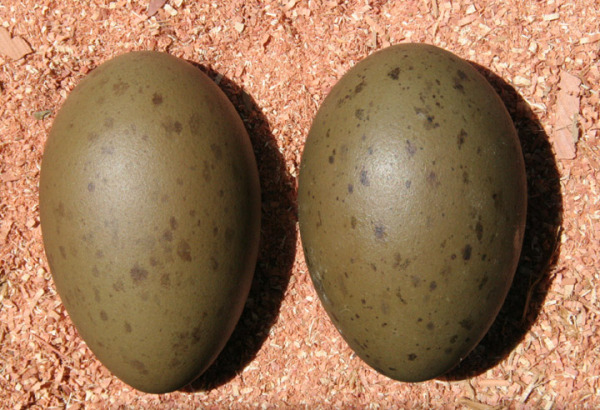
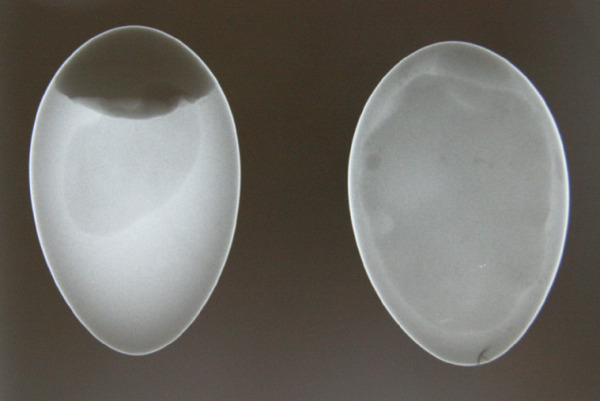
I received report from the DNR about the eggs with pictures of the eggs and the X-ray.  I thought you might like to see them so I tried to upload them here but could not.  So I sent them to MN Bound and have asked them to post them so that you can see them.
 
Here is the latest that came with the pictures [this is similar to what I already gave you]:
"Hi, Larry. I have attached a photo of the X-rays of the two loon eggs. One appears to be infertile from the outset, with no air sac. The other one on the left has an air sac and a dark area under the air sac that could be the yolk-or an embryo that died early in development. I will find out this week when I blow the eggs. I have also included photos of the eggs for you. Best wishes, "
  
So once again it confirms that no matter how long we would have waited, the eggs would not have hatched.  So I think it was the right thing to do to remove them so that the loons could get on with their lives.
 
We had also talked about doing lead and mercury testing but a biologist said it would not show much reliable information because of the way the body handles lead and mercury.
 
So now we work on trying to identify loons that can be part of the satellite tracking project.  This has the potential for adding major knowledge about loons.  And especially about those loons that may go to the Gulf of Mexico this fall and have to deal with the after effects of the oil spill.  
 
VERY little is known about loons on their wintering grounds.  Almost no studies have been done.  So this will hopefully add even some basic information.  And then you add the challenge of the oil spill and knowing what the effect of that is, this could be some very valuable information for generations to come.
 
If any of you know of lakes that have loons with chicks from this year, there is still time to send the information to LoonCam@yahoo.com to have them considered for inclusion in this study.
 
Let me once again say how much I appreciate you!!  All of you have been just amazing.  Your knowledge that you already have about loons is impressive.  And your desire to learn even more about these wonderful birds is encouraging.  Your kind comments about the LoonCam and my blog have been humbling.  
 
So THANK YOU more than words can tell!

Sunday, June 20, 2010 7:07am CDT


58 degrees  Clear  Wind ENE 2mph


Under a cloudless blue sky, several loons swim together across the lake.

There are some clouds further to the north but here our loons swim in bright sunshine on this Father's Day and the last day of spring.  The first fishermen of the day are making their way out to their favorite fishing spots.

Today loons all over the north country once again get on with living their lives.

Some now have chicks to raise.  Others are still on the nest hoping for new chicks.  And others, like our loons, will simply get on with their lives of swimming and fishing and preening.

They will bless and enrich our lives with the view of them majestically and peacefully swimming with such grace and ease.  But especially they will stir something deep within us every time we hear that call.  The call of a loon.  A call unlike any other.   A call with the ability to move us like no other bird.  To immediately conjure up memories.  To bring us back to places and times from long ago.  Whether it be time at a lake cabin or travelling by canoe through wilderness lakes or nights laying in a tent listening to the loons calling.

A call with the ability to transport us to another time and place.

Even if we have never heard or seen a loon first-hand, we are immediately captured by their beauty and grace in the water and their haunting call.  Or we are amused by their ungainly difficulty of maneuvering on land.

But no matter what it is, loons seem to have this ability to touch us in a way that very few other things can.

And so we will enjoy every glimpse of them this summer.  Until the approach of fall decides to take them from us for another year.

We can only hope for their safety as they return to the Gulf of Mexico and the Atlantic Coast.

If we are able to track some of the loons by satellite through this research project that is being planned, it will add so much more information to the base of knowledge about what is known of loons.  Not only their migration patterns but also more about their life and behavior while they are on the ocean.  So very little is known of this part of a loon's life.

Thank you for those of you who have sent me information about loons on the lakes that you have observed.  Especially if you have loons with chicks this year on the lakes where you are, would you please let me know at LoonCam@yahoo.com.  I will pass that information on to the researchers as they try to decide which loons they will monitor and which will give them the most useful information.

Many times knowledge does not come in blinding bursts.  Most of the time it comes in a little piece here and a little piece there.  But then when you stitch all those pieces together you end up with this beautiful quilt or tapestry of the life of a loon.

So hopefully, even through the LoonCam we can add another square to the quilt.

As the LoonCam 2010 season now winds down, it is with a tinge of sadness.  Not sadness about all that we have seen and learned and experienced, but sadness that it is over for the year.

Who could have predicted at the beginning of the year all that we would be a part of this year!

Eggs laid in a snow storm.  A loon sitting on the nest surrounded by heavy frost.  Blazing sun and heat.  Cloudy rainy days.  Battles with other loons.  Eggs knocked out of the nest into the water.  Possibly a change of which pair of loons is using the nest.  Two eggs that for whatever reason never had a chance of hatching.

So many twists and turns that tugged at our heart strings over and over and over.

That made us laugh.  That made us cry.  That made us sit back and just marvel at the miracle and magnificence of it all.

Nature is not predictable.  Nature writes a different story than what we expect.  And it is not at all the "perfect" story that we in our perfect world view would have written .  But it is always a story that captivates and is interesting.  And ultimately, it IS perfect.

As you have seen, the loons pay very little attention to the nest any more.  It is now just like any other spot on the lake.  And they very seldom even come up to the nest.  They have moved on and it no longer has the hold on them that it once did.  It is amazing the change that takes place in their bond to the nest.  Once again it is one more thing that we find so difficult to fully understand.

I will try to periodically post some information to let you know what I see of the loons.  But without chicks to hold them at one spot on the lake, the viewings this year will probably be much more  few and far between.  But I will try to let keep you up to date.  And I will let you know what happens with the research project.

We had looked at possibly doing lead and mercury testing with the two eggs that did not hatch this year.  But biologists tell us that with the way lead and mercury are handled within the body of a loon, testing of the eggs does not give us a good indication of the effects of these two toxic environmental metals.

We will try to save the shells of the eggs to be used for educational purposes with kids...of all ages!

Tonight we will turn off the camera for this year.  But we look forward to a new season in 2011.  So tell your friends and neighbors to watch for it along with you.

But plan on being with us in 2011 for another season of watching our favorite birds...the Common Loon!

LoonCam@yahoo.com

Saturday, June 19, 2010 8:53am CDT


64 degrees   Partly Cloudy  Wind NW 7mph


When the second egg was removed from the nest, it very rapidly broke the bond that the loons have with the nest.

Where before they had been willing to defend the nest, they now have little interest in it.  In the first day, they got back up on the nest a couple times.  But as far as I have seen, I do not think they have been up on the nest since.  They swim by once in a while but seem to have no interest in getting back up on the nest.  But even those times that they swim by the area where the nest is are few and far between.

It is surprising, but not unexpected, how quickly their behavior and their interest in the nest can change.

The power of that urge to lay those eggs and create a new generation of loons is so strong and one that we will probably never completely understand what causes it.  But it is universal.  We can simply observe it and describe it but I don't think we will ever totally understand it.

Now the loons are getting on with their lives.

They are not tied to the nest.  And they are not tied to two small needy chicks.  Without a nest and without chicks, they do not need to defend their territory like they did before either.  That has a lot of implications.  They are more sociable with other loons.  There are fewer fights.  And unfortunately there are fewer calls.

Part of what we see with calls of the loon that we so delight in is due to defending territory and protecting the nest and chicks.  So it is a catch 22 for us.  We want them to be free from being needlessly tied to a nest and we do not like to see fights and conflict.  But it is those very things that produce the calls that we love to hear.  So we are torn.  We want the calls of the loon to puncture the quiet of twilight.  But we don't want any of the negative things that sometimes produce those calls.

We all love those calls when we are 'up north' at the cabin or when we are out camping.  In so many ways, the call of the loon is quintessentially the definition of what it means to be 'up north'.

But as I have said to many people, I enjoyed loon calls much more before I knew what they meant.  Especially the tremolo and yodel alarm calls.  I still enjoy them very much.  They still thrill me and stir something deep down in my soul.  But now when I hear an alarm call my first thought is not to simply sit back and enjoy the sound.  My first reaction is to go see what is disturbing the loons!

May we all be able to be thrilled and stirred by loon calls for many years to come as we learn about them and take care of some of the things that they need to thrive.

We have already talked some about the Gulf oil spill and its potential impact on our loon population.  The possible negative impact is hard to overstate.  We can only hope that the spill is stopped soon and that the cleanup is fast and effective.  The first arrival of loons on the Gulf in October or November is not all that far away.

Amazingly, very little is known about loon's behavior and life when they are on the ocean.  The 'basics' are known.  But little is known about all the details.  So much more needs to be learned to fully understand these wonderful birds.

For instance, did you know that loons are one of the few birds who is uniquely equipped to survive and thrive on both freshwater and on salt water?

As humans, we are made for fresh water.  But if we are stranded at sea without fresh water, we will die.  We are incapable of drinking salt water and surviving.  That is part of the origin of the phrase "Water, water everywhere and not a drop to drink."

But a loon is able to make that transition with ease.

It has a special gland in its forehead that is able to filter excess salt out of its system!

And that extra salt is excreted through its nares (nostrils)!!!

One more amazing fact about our amazing loons.

I mentioned the other day that there were some very exciting and interesting things that are being talked about.  One of those things is that some researchers are looking to implant satellite tracking devices in a few loons so that we can learn more about their migration routes and where they go - whether they go to the Gulf of Mexico or to the Atlantic Coast.  There is some data about that but it certainly is not fully understood.

And now the oil spill adds increasing urgency to understand some of that journey and what happens to them while they are on the ocean.  To fill in some of the blanks of what is known about them during this time.

Our loons would have been prime candidates for that study because we have so much data and background information on them.  But one of the conditions of this study is that the loons that are tagged with satellite tracking devices also have chicks this year.  So our loons are ruled out of the study.  That is what I was speaking about a few days ago when I said that there were some exciting things being discussed.

How good would it have been to learn even more about the loons that we have spent so much time watching and have come to care about and love.  To know where they go in the winter.  To know that they are ok and not being adversely affected by the oil spill.  To know if it is the same pair that comes back to the nest next year.  So many questions that could be answered.  But, alas, it is not to be.

But there is a need to locate loon pairs who do have chicks this year as possible candidates for this study which will add so much to our body of knowledge about loons.

So if you have a pair of loons that you have been watching this spring that DO have chicks, please let me know!  You can contact me at  LoonCam@yahoo.com.  Let me know what lake they are on, how many chicks they have and any other information you have.  It may be that 'your' loons could be prime candidates for this study.

Time is of the essence in identifying potential loon families to be studied because they will need to be identified and tagged by the middle of July.  So if you have loon pairs that you know about, please send me an email.  And let some of your friends who have been following the LoonCam know about this as well.

Because of the location of the researchers, preference will be given to Minnesota or Wisconsin loons and the closer to the Twin Cities, the better.  You could be part of helping us learn so much more about our favorite birds!

The bird that  is the source of that 'call of the wild'!

LoonCam@yahoo.com


Friday, June 18, 2010 5:12am CDT

61 degrees   Scattered Clouds  Wind S 2mph
 
 
This morning the pink in the northeastern sky announces the impending sunrise.
 
The lake is calm.  The birds are singing.  Much like yesterday morning.
 
But so much has happened in between!
 
Last night tornadoes broke out across the state of Minnesota.  Our first of the year and the 5th latest date to have the first tornado of the year.  There were numerous tornadoes throughout the state from north to south, with at least two dead and many houses destroyed.  Our thoughts and prayers go out to them.
 
But for our loons here, there was no severe weather.  One cell which had produced tornadoes came uncomfortably close as it passed by, we only got a nice rain out of it.  But it illustrates what our loons and others may face on a moment's notice.  I am sure there are nesting loons someplace that did not fare as well.
 
And so today promises to be a quiet and peaceful day for our loons.  Highs in the mid-80s and no severe weather.
 
As you have seen, the loons have not been in sight of the camera much at all although they have a few times gone swimming by the nest but have not stopped.  "Flying tremolos" this morning indicate that at least one loon is flying in the area.  The plan right now is to leave the camera running this weekend so that you can maybe get a glimpse of them and then we will shut it down for the year.
 
Yesterday, I received a report about the eggs from the DNR. 
 
"Hi, Larry,
I just got back from the Wildlife Rehab Center.  The x-rays showed that the egg that floated out to the lake was infertile.  The second egg had an air sac at the large end and a small dark "object" just under the air sac that could have been a partially decomposed embryo."
Obviously if there is a 'partially decomposing embryo' inside, it had not developed far enough to even be defined.  So it appears that it was the right decision to remove the eggs from the nest and let the loons get on with their lives.  Neither egg would have ever hatched.  And how long they would have futilely sat on the nest is anybody's guess.  
We may still do some more with the eggs and I will give you any further updates.
 
A couple people asked "Why not just break them and look inside?"  There are still other tests that may be done.  But in addition to that, just being able to save the shells can provide a wonderful teaching aid for school kids.  Or will add to the specimen reference 'library' of some educational institution.  The idea is to do the least damage while extracting the maximum amount of information.
 
I had meant to give you before some of the measurements that I took on the second egg.
Length   3 1/2 inches    (89.5mm)
Diameter   2 1/4 inches    (57mm)
Weight    Approximately 140 grams   (4.9 ounces)
Volume    Approximately 150 cc
 
This egg is just slightly larger than the egg that was bumped into the lake by the loon.  This leads me to believe that this was the first egg that was laid this year.  Research has shown that the first egg laid is usually a little bit larger than the second egg.
 
We are looking at the possibility of some other research.  I can't say too much more right now but it requires a pair of loons that had chicks that hatched this year.  So our loons are not candidates anymore.  If you know of a lake that had a hatch of chicks this year, would you let me know either here or at LoonCam@yahoo.com?  If they are closer to the Twin Cities metro area, that would be an advantage.
 
I may be able to give you some more information in the next few days.  I know it is something that you will be very interested in, if they are able to pull it off.
 
So today brings a number of good things.
 
Confirmation that it was the right thing to remove the remaining egg from the nest.  And let our loons get on with their lives.  The promise of a beautiful day for our loons.
 
And the best thing of all.....our loons themselves!
Calling.  Swimming.  And just knowing that they are there!
 
Knowing that at least in this little corner of the world, the symbol and sound of the northern woods is doing well.