Wednesday, July 14, 2010 11:08pm


72 degrees  Calm  Partly Cloudy


Let me first of all answer the question that you are most concerned about.

Our loons seem to be doing well.

A few days ago we were in the lake swimming and both loons came swimming in fairly close to us.  They looked good.

Then today one of them was swimming not too far away and called a number of times.  When I called back to her, she answered.

Today was an absolutely tropical steamy day.  At one point the dewpoint was reported at 86 degrees!!!  And the air temperature was in the low 90's with a heat index of 106 degrees.   For Minnesotans, that is almost unheard of and unbearable.  But at least the loons are able to be in the water to stay cool.

I want to share something with you that happened Monday night.  I was going to wait to tell you until the news had been officially released but it seems to be all over the place today so I guess it is okay to share it with you now.

On Monday night, I had the privilege of being part of a team that surgically implanted satellite transmitters in a couple of loons.

The project was overseen by the United States Geological Service, under the direction of Kevin Kenow, along with the Minnesota DNR.  This was the project that I mentioned to you some weeks ago where we were looking for loons that had had chicks this year.  I want to thank so many of you who sent me information that I could then pass on to the USGS and the MN DNR.  Carrol Henderson, who I have introduced you to before and who is the head of all the non-game programs for the Minnesota DNR, was also with us that night.

They chose 3 lakes for the project....2 lakes on the St John's University campus and one lake near Monticello Minnesota.  Thank you to Dr Carol Jansky at St John's University and Pattie Roggenkamp near Monticello for giving us information about the loons on these lakes.  In addition, the USGS is going to do another 7 lakes in Wisconsin.  I had planned to wait until they had finished their work in Wisconsin and we had more information about that.  But since it was all over the television news tonight here in Minnesota and in a number of newspapers, I wanted you to be the 'first' to know and not the last.

The plan was to surgically implant a satellite transmitter into 3 loons [one from each lake] that night and then to band all of the loons that we captured and also attach a data recorder to their legs.

The satellite transmitter will communicate directly to a satellite thousands of miles above the earth and will report their exact location back to the USGS.  Kevin Kenow and the USGS have done this several times before.  In 1998 they tracked some loons from Minnesota and Wisconsin and then in 2003 to 2006 they tracked a number of loons from New England.  So the idea is not new but the technology has improved greatly.

It is still hard to fully comprehend the technology that allows us to do something like this.  Now with the Gulf oil spill [or as I like to call it, the Gusher in the Gulf...oil 'spill' is much to benign a term for the amount of oil that has been released], it is even more important that we understand better where loons migrate and what happens to them when they get down on the Gulf.  I may say more about that in a minute.

The data recorder that was attached to the leg along with the colored bands would record the loon's location, the temperature and their altitude or depth.  All of this would be recorded within the device which would then have to be retrieved at some point to download the data.

All of this information will help to fill in so many blank spots in our understanding of loon migration and activites on their wintering territories.  There is a real lack of information about loons during their time on the ocean during the winter.  So hopefully this can add some new information and help us understand them better.  This now becomes extremely important with the Gusher in the Gulf and with the potential tragic consequences of that oil.

When the project was first proposed, right away we thought of 'our' loons.  The loons that so many thousands upon thousands of people have watched and fallen in love with.  The most famous loons in the world.  And also the most documented and observed loons.  The loons that each of you have made so famous.

But one of the requirements for this project was that they have chicks from this year.  Partially that is to aid in being able to capture them.  And partially to be able to track the chicks.  And so because our loons did not have chicks this year, of all years, they were ruled out from being in the study.  We were all disappointed.

On Monday night, a group of us gathered at St John's University.  While we waited for the arrival of the USGS personnel from Wisconsin and the veterinary surgeon from Florida, a number of us walked out along one of the beautiful trails through the woods along the lakeshore to see if we could find the loons.  Without too much problem, we found the loons and the chicks swimming on the other side of the north end of the lake....the opposite end of the lake from where they had nested.

Shortly after we returned to the science labs, the USGS crew pulled up with their canoe and with their trailer where the surgery would be done.  The trailer was a 'recycled' FEMA trailer.  I am not sure where it had been used, but the thought crossed my mind that it would be so appropriate if it had been used in New Orleans after Hurricane Katrina and now would be used for loons that would be heading back down to that same area.  I meant to ask but forgot to when everything started happening.

We all gathered for a briefing to go over the plan of action for the evening before heading out.

The plan was that we would capture 2 loons on each lake and capture the chicks as well.  That would make a total of 4 adult loons and 4 chicks on these first two lakes and then another two adult loons and one chick on the third lake for a total of 6 adult loons and 5 chicks.  Then they would surgically implant the satellite transmitters in the male loons.  All of the loons would be fitted with colored leg bands for visual identification in the future and also fitted with data recorders recorders on their legs.

The same thing would then be repeated on the third lake some 30 or 40 miles away.

The way one captures a loon for this project is the same way one captures a loon for 'simple' banding.

You wait until it is dark.  The darker the better.  You do not want the loon to be able to see you.

You go out onto the lake after dark and try to find the loons.  One of the reasons that you want them to have chicks is that they will likely be swimming together and more importantly, the parents are very protective of the chicks.  The chicks need to be several weeks old in order to be fitted with any kind of bands or data recorders.  Otherwise they are too small.

When you locate the area where the loons are, you play a distress call...which as all of you know is either a tremolo or a yodel call.  This says to the adults that there is another loon on the lake that is intruding into their territory and is also a possible danger to their chicks.  So the adults come to investigate who this intruder is.  Also, since they have chicks, they also tend to stay on the surface of the water more.

When the loon comes close to the boat to investigate the intruder, you shine a bright light in his eyes so that he cannot see either the boat or see you.  This allows you to use a very large fishing net to scoop the loon out of the water.  The loon is put into a crate for transportation back to shore and then back to the 'base camp' for the surgery and/or the banding.

So about 10:30pm it was decided that is was probably dark enough to head out to the lake.

But as with most things in life, there are the plans that are made and then there is the reality of what actually happens.

So tomorrow I will try to tell you some of the rest of the story.

Thursday, July 1, 2010 12:32am CDT

63 degrees   Quiet
 
I wanted to share with you information that I just received today from Carrol Henderson at the Minnesota DNR about the two eggs that did not hatch.
 
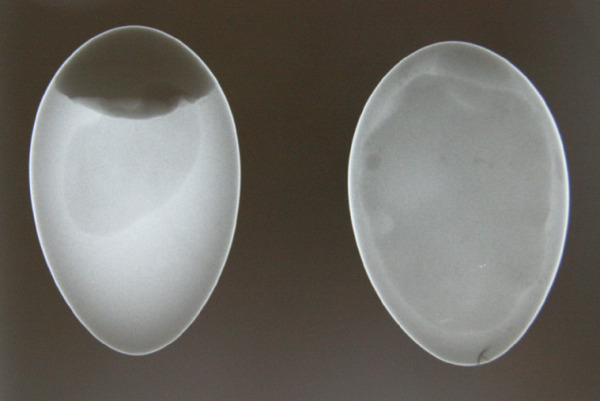
As you know, we had them x-rayed and the x-rays showed that one had not developed at all and the other one had a "small dark spot" just under the air sac.
 
Here is what Carrol's email from today said.

"Hi, Larry,

Well, on Sunday afternoon I mustered all my courage and gathered up the two loon eggs from the refrigerator (I promised Ethelle they wouldn’t smell!) and took them to the backyard with my egg drill and oologist’s blowpipe tool for blowing out the eggs.  The egg that you picked from the nest was totally rotten—infertile.  The second one that had the air sac and had floated into the lake had a small embryo of a loon chick which would have been the dark mass just under the air sac.  It had apparently died early in incubation. Uffda did it smell awful, and by the time I finished after about 30 minutes, I had a large entourage of flies observing  the process.  I have refrigerated the eggs and need to get back to them to flush out the inside of the eggs with water to remove more of the smell. They are still pretty rank."

So he has gone WAY beyond the call of duty to give us the maximum amount of information about what happened with the eggs!  He is a great person to work with and he is in charge of all the non-game wildlife programs in Minnesota!

Then he also said, "It looks at this point like we will be able to capture the three loons that we need for the satellite transmitter project at sites that include some that your contacts have provided. I will  keep you posted on our progress."

So thank all of you who gave us some insight and information about loons that have had chicks this year.  As I find out more, I will try to keep you informed.

Once again, I hope that all of you in the US have a wonderful and safe 4th of July.

And just a reminder if you are on lakes anywhere there are loons.  Remind the people you are with to be on the lookout for loons.

Adults can do fairly well with boat traffic and dive out of danger.  But even so there have been reports of adult loons hit and killed by boats and jet skis.  So just ask your family and friends to be aware that they are sharing the lake with loons.

But more important are chicks.

This is probably the most vulnerable time for chicks.

Their first two weeks of life are when there is the highest chick mortality.  Once they make it beyond two weeks, their life expectancy goes up dramatically.

Why is that?

There are several reasons.  For the first few days to a week of their life, chicks cannot dive.  They will try to dive but at most they go down a couple inches and then just pop up to the surface like a cork!  So if a fast boat or jet ski is headed straight at them and bearing down on them, they may try to dive but they cannot dive deep enough to get out of harm's way.  And they are so small that unless a boater is being very observant, he will probably not even know that he has hit and killed a baby loon.

Secondly, with a lot of boat traffic, there is a chance that the chicks will be separated from the adults.  Not only are they in danger of being hit, they are also then in danger of a large fish or turtle eating them or an eagle or gull snatching them.

So they enter one of the most dangerous periods of their lives.  And unfortunately the busy 4th of July weekend coincides exactly when so many loons have their new chicks out on the lake for the first time.  If they can make it through this weekend and the first two weeks of life, the chances of them surviving are very encouraging.

You can help by just reminding your family and friends to be on the lookout for loons and new baby chicks when they are out on the lake.  You could very well save a new generation of loons!  And with the threat of the Gulf oil disaster looming for our loons, every chick is especially important this year.

So have a wonderful holiday!  Enjoy your family and friends and our history.

And especially enjoy our LOONS! 


Tuesday, June 29, 2010 5:49pm CDT


72 degrees    Sunny   Calm 


What a picture perfect summer day.  Sunshine.  Blue sky.  An even bluer lake.  And no humidity!

In the words of the old commercial, "From the Land of Sky Blue Waters!"

And what a perfect day for the release of a loon!!

I got a call from the Executive Director of the Wildlife Rehabilitation Center this morning to tell me that they were ready to release the loon - "Sue's loon" which has now become "Jodi's loon".  [Jodi, I had understood that your name was on the admittance tag but did not know the connection between you and 'Sue' until I saw your message.  Btw, I bought my pontoon from your family!!]

I was so surprised to hear that the loon was well enough to be released.  In fact, they were already on the way to the lake with the loon.

Yesterday afternoon I was not encouraged by the news at all.  The news that the loon still was not able to use it leg and was just sitting on a platform in the water was not what I had hoped to hear.  And then to hear that there might be nerve damage to the leg added to my concern....even if the word was that the nerve damage "could" heal.  There were no guarantees that the nerves WOULD heal.  Or guarantees of how long it would take to heal.

So I was surprised but elated to hear this morning that the loon was already doing well enough to be released today.  I was honored to be asked to help with the release on a moment's notice.  So in between a meeting this morning and a doctor's appointment right after lunch, I quickly headed to the lake where the loon was originally found.

There I met one of the staff members from the WRCMN and we carried the container with the loon inside to the shore of the lake.

There was another loon swimming not too far from the landing where we were going to release this loon.  We both wondered if that was the mate to this loon.  I looked carefully and there were no chicks swimming with the single loon.  That alone was encouraging but there was no way to know if these two loons were mates.

I was surprised at how calm the loon was as I opened the door of the carrier and reached inside to carefully take hold of the loon.  I had expected to hear some calls and for the loon to struggle.  But it didn't.  Only some disarrangement of feathers indicated anything was wrong.  I tried to be very careful and gentle with the loon's left leg which is the one that had been injured.

I was fully expecting the loon's feet and wings to be fluttering and flapping all over the place.  And I was especially careful and concerned about that sharp bill!

But the loon was perfectly content for me to pick it up and hold it as I walked to the water.  There was no struggle.  No panic.  No distress.  Only a couple of quiet hoots.

I gently set it into the water.  Even then it did not panic in any way.  I had expected it to very quickly swim or paddle to get away from us.  But it didn't.  It swam a few feet away from us and then turned and looked at us.  Still no urgency to get away.

It was good to see that it could use its left leg... the one that had been injured.  If it had not been able to use that leg, it obviously would not be able to swim well.

It swam several leisurely circles and stayed very close to us...only a few feet away as we watched from shore.  It started to rearrange its feathers that had been all tousled up in the transfer.  

And then that iconic loon pose as it rose up out of the water and flapped its wings as if to say "Free at last!  Free at last""

It also would not have been able to rise up in the water like that if it did not have good use of both legs.  And then it slowly and quietly started to swim out into the lake.

We were hoping that it would call to see if the other loon responded.  But it did not call.  Only a couple of quiet hoots as if to say "Thank You".

But the other loon did start to swim in the general direction of the loon that we had just released.  But there were no calls.  Only the quiet of a beautiful summer day punctuated by the sound of boats and jet skis.  People who were totally unaware of the awesome event that had just taken place within their view.

We did not actually see the two loons reunite so we cannot be sure if it was the mate or not.  But there were no fights that we observed either.  Everything seemed to be peaceful and the release had gone better than we had a right to expect.  Best of all was that the loon seemed to be doing VERY well and did not seem to have any trouble swimming or diving or rising up to flap its wings.

So thanks again to the Wildlife Rehabilitation Center of Minnesota and their excellent staff for nursing this loon back to health.  And thanks to Nate and Jodi for saving this loon and starting this whole saga which had a wonderful ending!

Hopefully everyone on the lake will hear the loons calling tonight!


Monday, June 28, 2010 10:12pm CDT


62 degrees  Clear   Wind N4mph


What a spectacular evening!

After all of the heat and humidity and storms over the last week or so, we are now into a stretch of perfect weather.  Sunshine.  No humidity.  Bright blue skies.  Light breezes.  And tonight  a spectacular sunset.

Golds and reds and crimsons and purples.  And bright rays of sun shooting up into the sky from below the horizon.  And all of it reflected in the bright blue water of the lake.  These long days of summer give the extended times of twilight that are so magical.  And so practical.  They allow you to get caught up on lawn mowing until almost 10pm!

I wanted to update you on a couple things.

A couple days ago, the loons paid a visit and came swimming by.  They came in quite close to shore and near the nest which has been pulled into the shallows by the dock.  It was like they were just taking a drive through the old neighborhood to see where they had lived and what was happening with the neighbors.  They did not stay long but just long enough to show that they still remembered and had an interest in the area.

Most of the time I do not see much of them during the times I am home.  But an occasional glimpse here and there is always nice.  They look like they are in very good health and doing well.   A couple times I have seen them with other loons on the lake.  And it is always so special when you hear them calling at night.

They don't call near as much as when they are defending territory or when they have chicks, but the occasional call is still enough to stir the soul deeply!

So rest assured that they seem to be doing well.

Some of you have asked about seeing groups of loons together and wondered if this was normal.

If they are not defending nesting territory or if they do not have chicks, it is quite normal.  Typically these would be loons that have not mated or loons who do not have chicks for whatever reason.

As you know, loons stay down on the Gulf of Mexico for the first 2 or 3 years of their lives.  But even when they come back north, they usually will not mate until they are 5 or 6 or 7 years old.  So the groups of loons that you are seeing could be some of these loons that have not yet mated.

The other thing that I wanted to update you on is the loon with the 'bad leg' that Susan and her son rescued.

I talked with the good people at the Wildlife Rehabilitation Center of Minnesota this afternoon.

The loon seems to be doing well but has a long way to go yet.

X-rays did not show any broken bones, which is good.  They feel that the reason the leg is stretched out behind is either because of soft tissue damage or possibly nerve damage.  There is no way to tell at this point what caused the injury.

I was especially concerned when I heard the words "possible nerve damage".  But they assured me that nerves can and often do heal themselves and that it is not an automatic bad diagnosis.  So all they can do is watch and wait and take care of the loon while it hopefully heals and can be released back into the wild.

However, with loons time is the enemy.

Whereas many birds can survive and even thrive in captivity, loons do not do well in captivity at all.  And few survive.  Ask yourself, when is the last time you saw a loon at a zoo.  You probably never have because there are very few zoos that even attempt it because loons are almost impossible to keep in long term captivity.  They truly are birds of the wild and part of the reason that we so identify their calls with the great wilderness areas of the north.

The folks at the Wildlife Center have graciously told me that they will try to let me know of the loons progress so that I can pass the word on to you.

If you would like more information about the Center itself, you can find them at wrcmn.org

They treat thousands upon thousands of animals each year.  They are the second largest center like this in the US, second only to a center in California.  However, the California center also treats raptors, which the Wildlife Rehabilitation Center of Minnesota does not.  But we are also fortunate enough to have the Raptor Center [http://www.cvm.umn.edu/raptor/] here in Minnesota which is also a world-renowned center.  They told me that when you combine the figures of the Wildlife Rehab Center with those of the Raptor Center, no one else in the country comes close to the number of animals treated.

So we can thank the Wildlife Rehabilitation Center for all of their good work, including the x-rays that they did on our loon eggs a couple weeks ago!

They also got another loon in yesterday from Wisconsin!

You will remember that I told you how during rainstorms loons (and other waterbirds) can sometimes mistake highways and parking lots for bodies of water and land on them.  Ducks and other waterbirds can take off when they realize their mistake.  But a loon is trapped.  He cannot take off without a long body of open water.  And so he will die unless he is rescued.

Someone was kind enough to rescue this loon also and bring him to the Rehab Center.  They said he was in good shape except for some abrasions on the bottoms of his feet.  He will also be released when it seems safe to do so.  That release will probably before "Sue's Loon" is able to be released.

So that brings you up to date on both our loons and also the loon that was rescued.

I will try to let you know of any other information as I get it.

So until we talk again, I hope all of you have a wonderful and safe 4th of July!

And watch out for loons while you are out on the lake.

Monday, June 20, 2010 9:44pm CDT

69 degrees    Magic Twilight   Calm
 
Was last night amazing or what?!!
 
It was as if the loons really wanted to say 'Goodbye' to you!
 
They called over and over and over.  It is the most calling that I have heard since the night I took the egg off the nest and they called back and forth to another pair of loons before they even knew the egg was gone.
 
I could not believe how long and how often they called.
 
It was bittersweet for all of us for this adventure this year to come to an end.  Again let me tell you that I will periodically post an update for you.  They will probably be few and far between because without chicks the loons will be out and about more.  But I will try to update you once in a while.
 
Tonight I took in the swimming raft and the buoys and moved the nest closer to shore.  So now boats and fishermen do not have to worry about it.  I haven't taken the nest up to shore yet nor taken all the equipment apart.  But I will soon...I am gone for the next couple days so it will have to wait until after that.
 
It gave me a chance to have a closer look at the nest for the first time since I put it out over two months ago.  Can it really be that long ago?!
 
There are several of the willow branches near the camera and microphone wires that definitely had been gnawed.  You will remember that I was VERY concerned that the muskrat would gnaw through the cables and shut everything down.  There was no sign that he had gnawed on the wires but he definitely had gnawed on the branches!  And it was only an inch or two away from the cables....MUCH too close for comfort!
 
I also tried to see what he was so intent on eating night after night when the loon would reach out and poke him.  There was no creeping Charlie, green or dry, left in that area.  I still cannot believe that he was intent on eating creeping Charlie but it may be.  The other possibility is that I had put a cattail root over in that general area.  It seem more likely that that is what attracted him but I am not sure.
 
Also, the bowl of the nest was surprisingly shallow.  More shallow than what I have usually seen.  So it is no wonder she bumped the egg out of the nest twice.  And I have never seen that before.  I have to wonder what effect the MANIC nest-building played in that.  When she was just THROWING material up on the nest!  With the eggs already in the nest there was not the opportunity to use her feet to deepen the bowl like they would normally do.
 
Once again, behavior that I have not seen before.  I keep asking myself if this was a new and inexperienced pair of loons just learning everything for the first time.  She really had taken almost all the vegetation she could get loose from around the iris and daylilies.  They were left high and dry!  It is amazing that they even survived.  She had even gotten one small daylily bulb up INTO the nest where it was growing!
 
The side of the nest facing out to the lake was especially low and I think that contributed to the egg ending up in the lake.
 
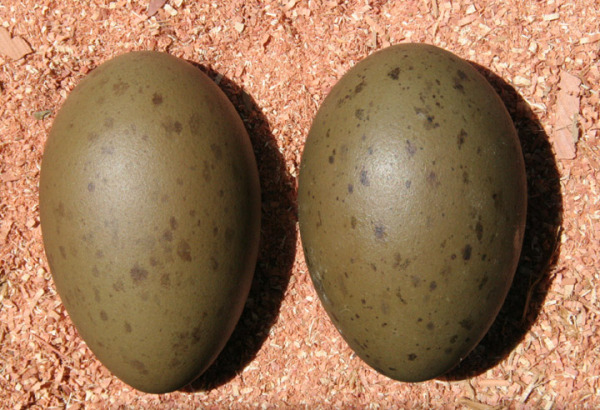
I received report from the DNR about the eggs with pictures of the eggs and the X-ray.  I thought you might like to see them so I tried to upload them here but could not.  So I sent them to MN Bound and have asked them to post them so that you can see them.
 
Here is the latest that came with the pictures [this is similar to what I already gave you]:
"Hi, Larry. I have attached a photo of the X-rays of the two loon eggs. One appears to be infertile from the outset, with no air sac. The other one on the left has an air sac and a dark area under the air sac that could be the yolk-or an embryo that died early in development. I will find out this week when I blow the eggs. I have also included photos of the eggs for you. Best wishes, "
  
So once again it confirms that no matter how long we would have waited, the eggs would not have hatched.  So I think it was the right thing to do to remove them so that the loons could get on with their lives.
 
We had also talked about doing lead and mercury testing but a biologist said it would not show much reliable information because of the way the body handles lead and mercury.
 
So now we work on trying to identify loons that can be part of the satellite tracking project.  This has the potential for adding major knowledge about loons.  And especially about those loons that may go to the Gulf of Mexico this fall and have to deal with the after effects of the oil spill.  
 
VERY little is known about loons on their wintering grounds.  Almost no studies have been done.  So this will hopefully add even some basic information.  And then you add the challenge of the oil spill and knowing what the effect of that is, this could be some very valuable information for generations to come.
 
If any of you know of lakes that have loons with chicks from this year, there is still time to send the information to LoonCam@yahoo.com to have them considered for inclusion in this study.
 
Let me once again say how much I appreciate you!!  All of you have been just amazing.  Your knowledge that you already have about loons is impressive.  And your desire to learn even more about these wonderful birds is encouraging.  Your kind comments about the LoonCam and my blog have been humbling.  
 
So THANK YOU more than words can tell!