
Tuesday, May 10, 2011 6:43am CDT

 
53 degrees   Clear/Hazy  Wind  3mph E
 
 
Today promises to be the first day of the year that might actually feel like summer.
 
With temperatures predicted to get into the 80s for the first time this year, you will probably see the loon on the nest with its beak open much more than you have seen before.
 
The open beak posture is simply the loon's way of trying to cool off.  Much like a dog panting.
 
Loons seem to do much better at handling cool to cold weather than they are at handling hot weather.
 
But once again to day, their first responsibility will be to stay on the eggs and to keep them warm.  All the while being ever vigilant and looking around for any sign of danger.
 
Yesterday was an example of that once again.
 
Late in the afternoon I heard a couple of tremolo calls from the nest [remember 'tremolos' are one of the alarm calls for a loon].  When I looked to see what was upsetting the loon, there was nothing in sight that I could see that should cause alarm.
 
Then all of a sudden there came an eagle flying over, relatively low.  The eagle had two 'crows in tow' that were attacking it as it flew.  And more crows were flying in from all directions to join the chase of the eagle.  The crows did not want him around either.
 
But the loon had spotted the eagle when he was still far away and the loon knew that an eagle meant potential trouble for him and the nest.  So the tremolo alarm call was given.
 
What is always amazing to me is how the loons can distinguish what is a real threat and what is not a threat.
 
I have seen times when the loons are very upset and I cannot see anything for them to be upset.  But then high in the sky I see what is not much more than a black dot.  It is an eagle circling so high that it is hard to even distinguish it as an eagle.  And yet the loon has recognized it as an eagle and therefore it is a threat.
 
But an osprey can fly over and the loons hardly give it a second glance.
 
For those of you who have not seen one, an osprey is also a bird of prey.  It is often called a 'fish hawk' or 'fish eagle'.  It looks very much like a bald eagle only a little smaller.  But an osprey feeds almost exclusively on fish.  And therefore the eagle knows that it is not a threat.  
 
I have trouble distinguishin between a bald eagle and an osprey at a distance.  But the loon can do it easily.
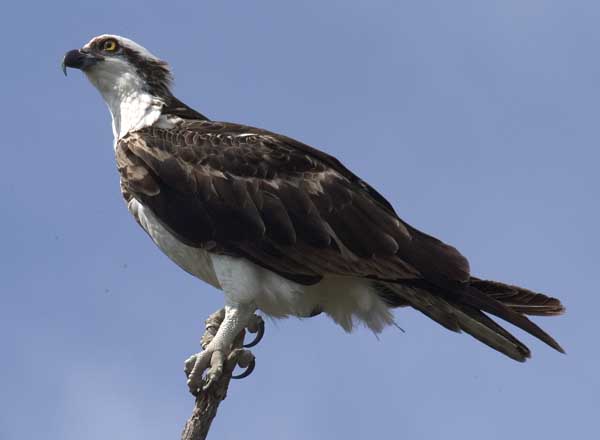
 
So the loons will react strongly to the presence of a bald eagle and yet react almost not at all to an osprey.  How they can so quickly and easily distinguish between the two is yet one more of the mysteries and miracles of loons.  And they are not telling us how they do it.
 
But they clearly know what is a threat and what is not a threat to them.
 
One of the other things that you may want to watch for today are black flies that fly around the head of the loon.  They have already been around a few days and with the warmer weather today and tomorrow, I expect that we will see more of them.
 
The black flies are very small so it may be hard to even make them out on the video unless you look very closely.  Watch for head movements and the loon rubbing the head against its back as a sign there are black flies there.  Or occasionally the loon will 'snap' at things in the air that you may not even be able to see.
 
Maybe tomorrow I will say a few words about the black flies that torment loons.  That is yet one more amazing story in itself.
 
But so far today, the loons are enjoying a quiet and uneventful day.  And the rest of the day promises the same for our loons.
 
But for the loons, they know that things can change in an instant.
 
 
Questions or Comments?  LoonCam@yahoo.com

Monday, May 9, 2011 6:11am CDT


54 degrees   Heavy Rain  Wind  Calm


Lightning.  Thunder.  Heavy rain.


Like the proverbial water off a duck's back, she lets it roll.

Just another spring morning for the loon on the nest.

Fortunately so far there has been no severe wind or hail.  Rain she can deal with.  Hail and severe wind could be another matter if it comes.  Even the wind has to be pretty bad before she would leave the nest.

So while we are off doing other things, the loons are there.  Faithfully.  For 28 solid days.  Come what may.

The eggs are not something that can be forgotten only to come back to them later.  In whatever way they can, whatever goes through the 'mind' they have, they know they have no greater responsibility than to nurture and protect those eggs every minute of the day.

It is not a responsibility that they take lightly.

We still have at least one other pair of loons on the lake.  So that continues to produce the periodic confrontations and 'yodel matches'.  I have been told that this other pair of loons has actually nested, although I have not personally seen the nest.

The danger in a situation like this is that if the loons can see each other, the possibility exists that they both may be pulled off the nest for these confrontations.  And that puts the eggs at risk.

I hope that both nests -'our' nest and the other nest - are successful.  But the existence of another pair of loons nearby raises the risk.

I am pretty well convinced that is what happened last year and why the eggs did not hatch. 

Some of you will remember the incident on a very cold frosty morning the eggs were left exposed to the cold morning air and frost for about 40 minutes as both loons were lured across the lake to confront another pair of loons.  And apparently the exposure of the eggs to the cold for that long was enough to harm them and neither egg hatched.

We can only hope that something like that does not happen this year.  But it is a reminder once again of the fine edge between success and failure for nesting loons.

But for right now, let the lightning flash.  Let the thunder roll.  Let the rain come down.

Our loon sits ever faithful on her precious charge of two eggs!  Safe, warm and dry under her protective body.


Questions or Comments?   LoonCam@yahoo.com


May 8, 2011 6:21am CDT

 
49 degrees   Clear   Calm
 
 
On this beautiful Mother's Day morning, an expectant loon sits on the nest.
 
A huge red ball in the eastern sky.  Birds in full morning song.  A blue sky with a few white puffy marshmallow clouds.
 
The cool morning air of a Minnesota spring morning produces ever so faint wisps of fog which skid along the surface of the glassy water.  They will be here for just a short time.  As soon as the sun comes up above the trees, it will drive them away.
 
The loon is watchful.  Her head twists from side to side surveying everything that is going on around her.  Always watching and ready to respond to danger that may come from any direction at any minute.
 
This is the scene that will be the norm for the next 4 weeks.  The silhouette of a loon faithfully sitting on a nest on a northern lake.
 
With nicer weather finally here, it also means increased activity on lakes across the lakes in the northern US and on into Canada.  More boats.  More fishermen.  More activity in general.
 
It is a testament to how adaptive loons truly are.
 
Whereas the ideal for them probably would be a lake with no human activity, they are able and ready to adapt to lakes with a lot of human activity.  It just makes things harder for them at times.
 
So on this Mother's Day, our loon faithfully sits on two new eggs.
 
What is happening inside those eggs is something too wonderful to comprehend.
 
How actual life can spring from 'nothing'.
 
How in a few short weeks there can actually be little fluffy balls of black down that are able to move and live under their own power.  Sometimes the miracles are right around us and we miss seeing them in the busyness of our lives.
 
On this Mother's Day, take a moment to stop and look at the miracles all around you.  Think of your own mother.  Your kids.  Your family.  Your friends.
 
The miracle of life itself.
 
And be thankful for all that God has given you on this beautiful day.


May 7, 2011 2:48pm CDT


76 degrees  Partly Cloudy   Wind  4mph E


It is a spectacular Minnesota spring day.

And we have had far too few of them this year.

But today makes up for it.  Light breezes.  Scattered sunshine.  And nature starting to belatedly burst forth.  Trees that should be mostly leafed out are just starting.

But one of the advantages of the cool and even cold spring is that the brilliant beauty of the yellow daffodils has lasted longer than normal.  So even when there are things that seem negative, they are offset by other things which are positive.

One of the biggest positive things we have today is the arrival of the second loon egg!

So now the loons can get down to the serious business of incubation of the eggs.  There is a slim possibility of a third egg, but I do not expect that to happen.  Three eggs certainly are not unknown but they are relatively rare.

If everything goes well over the next several weeks, we should expect to see chicks by June first.  I would expect that we may see them a day or two earlier than that.

It was amazing to watch the difference in the delivery of the two eggs.  The first egg was laid with what looked like great difficulty.  And to watch the reaction of the loon after she laid the egg, it must have been difficult.

I have never seen a loon take that long to recover after laying an egg.  I was beginning to fear that she may have even suffered some damage when she did not move for so long.

But the second egg was the exact opposite.

It happened so quickly and easily that I was not even sure she had laid an egg!

I wrote a blog entry saying that she had laid an egg....but I held onto it for  a while before posting it because I was not 100% positive.  When she did a quick egg turn, I "thought" I saw a glimpse of 2 eggs.  But even then I could not be sure.  So I thought I should post the note and apologize later if I had been wrong.

Fortunately she did not prove me wrong!

There were now two eggs.  The second egg was laid at 7:34am CDT.

Some have questioned the "tapping sound" on the microphone.  What is it?

Along with you, I wish I knew.  I have wondered the same thing.

The best answer I can come up with is that it may be one of the tiny willow branches tapping against the microphone in the breeze.  It is just a guess but it is the best one I have right now.  Obviously there is no way to go out to the nest to investigate.  It does not seem to be causing any problems other than being slightly annoying.

There is another sound I have heard a few times in the last couple days that does concern me.  It is almost a static sound.  I do not know what it is either but I fear that the muskrat may have gnawed some of the insulation off the microphone cable.   And once again there is nothing that can be done until after the loons have left the nest and we can inspect it.

Other than those minor problems, the microphone, camera and nest seem to be holding up quite well in the wind and rain.  Now only another month to go!!

You have seen and heard the many sounds and distractions that go on around a heavily used lake.

This is not a 'pure wilderness lake' that we so often associate with loons.  People live around the lake.  People are on the lake.  They use it heavily.  For fishing.  For skiing.  For sunbathing.  For all the normal things people use a lake.  And life goes on around the lake and on the lake.

Even fireworks!

Yes, I have confirmed that the noises you heard last night were fireworks.  Apparently one of the neighbors has friends here from out of state.  And those friends brought fireworks with them.  Apparently there were three or four blasts that were set off.  Surprisingly in the house with the computer off, we only heard the largest boom.

But it was fireworks.  Not anyone shooting a gun nor was it the beaver trapper.

Speaking of beavers, they are still VERY active.  And the trapper is planning to come out tonight to set his traps.

I for one wish that they did not have to trap them.  But there seems to be no other choice.  There has already been a lot of erosion and shore damage from the high water.  And if left unchecked, over the next couple years the lake would rise probably at least  a couple feet causing more damage and even potentially destroying some houses!

Some times one species takes precedence over another.  In this case, it is man over beavers.  Unfortunate but true.  Hopefully some of the other beavers in the lake and the area can be left alone if they do not cause undue damage.

So, many aspects of life go on around the loons.  

Some affect them directly.  Others not so much.

Many of you have been correctly identifying the sounds of the birds in the area, including a pair of sandhill cranes that may have taken up residence not too far from the beavers.

But the most important ones to us here, are the sounds of the loons.  And the 2 precious eggs that now grace the nest!


Questions or Comments?  LoonCam@yahoo.com