
Thursday, May 12, 2011 6:14am CDT


57 degrees  Cloudy  Wind 6mph N


On a cloudy, overcast morning, our loons wait for rain that is predicted today.

There are thunderstorms moving in but at this point nothing is predicted to be severe.  Yesterday's expected severe weather did not develop and the loons were able to spend a quiet day on the nest.

It is hard to believe that we are already one quarter of the way through the incubation period for the first egg, which was laid one week ago last night.  How fast the time goes.  One can only wonder and imagine what is going on inside that egg right now.  In only 3 short weeks, there should be a new little loon chick ready to enter the world!

Right now the nest bounces on small waves, what fishermen in Minnesota would call "a nice walleye chop".

This weekend brings one of the biggest days of the year in Minnesota - Fishing Opener.

In an annual right of spring, upwards of three quarters of a million people head to their favorite lake to go fishing.  Any kind of fish will do but they especially are after the walleye, the Minnesota State Fish.   http://www.dnr.state.mn.us/fish/walleye/index.html

The increased boat traffic also means that our loons are under increased pressure.

Fishermen who approach too close to a loon nest may scare the loon off the nest and leave the eggs exposed to the weather or predators.  One time off the nest may not have much impact.  But if it happens over and over, the effect can be cumulative and harmful to the developing eggs.

If you are a fisherman, or anyone who spends time on a lake anywhere in the country, there is a good rule of thumb for you when it comes to loons.

If you stay 300 feet away from the nest or loons with chicks, you will have very little adverse effect on them.

The loons will give you clues to let you know if you are too close to them.  Those of you who have watched the LoonCam for even a short time are very familiar with some of those clues.

The first thing a loon will do if a boat or canoe approaches is to slightly lower its head.  It is as if it is saying, if I lower my head they won't see me.

If the boat continues to come closer, the loon will go into what is called "hangover posture".  "Hangover posture involves the loon laying its head and neck right down along the side of the nest.   The loon is telling you that you are much too close and it is very concerned.

The next step beyond the "hangover position" is that the loon will actually leave the nest.  This is when the eggs become vulnerable to weather and predation.  If a loon is scared off the nest too many times, they may actually abandon the nest.

The wonderful thing is that it is VERY rare that someone purposely does something to harm loons.  It seems almost everyone loves this wonderful and unique bird.

But sometimes we can "love them too much".  By wanting to be close to them and see them up close, we may in fact put too much stress on them and inadvertently cause them harm without even knowing it.

That is where the LoonCam is so ideal.  We are able to watch the loon VERY closely and never put them under any stress.   We are able to see and hear things that not even the most accomplished researcher has ever seen or heard in the wild.  And never once causing stress on the loon.

So if you are a fisherman or if you know a fisherman, remind them to be aware of loons that are nesting at this time of year and to keep a respectful distance (300 feet) from them.  The loons will be much more relaxed and able to raise a new generation of loon chicks.  And everyone else will be able to enjoy the call of the loon for many years to come.

One of the other things that we fishermen can do to help our loons involves the fishing tackle that we use.

Most fishermen, including me, use lead weights and jigs.  There is no problem with that....UNTIL we lose them.

Loons pick small stones off the bottom of the lake which then act as 'grinders' of their food in their gizzards.  Loons do not know the difference between stone and lead.  And so if there is a lead sinker laying on the bottom of the lake, the loon may very well pick that lead sinker up thinking it is a stone.

All it takes is one small lead weight to give the loon lead poisoning and to kill it.

Just one more of the many challenges and dangers that loons face.  So more and more fishermen are replacing their lead tackle with lead-free tackle.  It is a good start but we have a long way to go.

So once again today enjoy this great view that the LoonCam gives you of this magnificent bird.  And remind your fishing friends to watch for loons and to keep a respectful distance away from them.


Questions or Comments?     LoonCam@yahoo.com
Wednesday, May 11, 2011 4:57am CDT

 
59 degrees    Cloudy   Calm
 
 
The loons (and all of us) dodged a bullet last night.
 
With the arrival of the first warm temperatures of the season, it was also the arrival of severe weather here on the lake for the loons.
 
Severe thunderstorms, large hail, lightning and tornadoes were all around.
 
Tornado sirens sounded several times.
 
But fortunately for the loons, nothing happened here.  Just a little bit of rain and fortunately no wind and no hail.  And especially no tornadoes although they were reported not too many miles away.
 
There were many reports of golf-ball sized hail and even one report of baseball-sized hail.  Now that could have done some serious damage not only to the eggs but to the loons as well!
 
There were numerous reports of tornadoes and funnel clouds all along a line that stretched across a good part of the state.  There were a couple reports of damage to homes but fortunately the damage was not widespread.
 
But it was a perfect illustration of how our loons must be ready at a moments notice to deal with danger that can come from so many directions.  These severe storms really were not expected but they suddenly popped up out of no where.  Today and tomorrow there are increased chances for thunderstorms and severe weather.
 
So our loons remain on guard and ever vigilant.
 
Right now the black of night is just barely beginning to give way to the first light of day.
 
The dark ring of the trees across the lake are only slightly visible and reflected in the mirror-like surface of the lake.
There is only the slightest hint of a sliver of light in the eastern sky.  You can't even call it light yet, only a hint of light!
 
Several yodel calls pierce the darkeness as the male broadcasts to anyone who will listen "This is MY territory!"
 
And from somewhere else out on the lake, another male answers with a yodel of his own.  This is apparently the male from the other pair that have been reported to have also built a nest in a back channel off the lake.
 
But for now it is dark enough that they cannot see each other.  They can only hear each other.
 
Many times when a male gives his yodel territorial call, he will stretch out his neck almost parallel to the water and blast out his yodel call to anyone or anything within earshot.  I have watched male loons give their yodel call and then turn 90 degrees to give it in another direction.  And then turn another 90 degrees.  And then another.  Broadcasting to all point of the compass to let everyone know that they are claiming this territory.
 
Yesterday I mentioned the black flies that often plague loons.
 
With warmer weather, the flies will increasingly become a problem.  They are especially noticeable as the fly around and land on the loon's head.  Unfortunately for the loons, they are flies that bite and feed on blood.
 
The scientific name of these  black flies is "simulium euryadminiculum".
 
But one of the most amazing things about these particular black flies is that they feed exclusively on loon blood.  Yes, you read that right.  They feed exclusively on loon blood!
 
Experiments have been done where researchers have placed loon skins from a museum and duck skins on the ground.  This black fly ONLY gathered around the loon skin.  Even skins that had been in museum collections for years attracted this black fly while they were not attracted at all to other birds or animals.
 
It is hard to believe that there is a black fly that is so highly specialized that it only feeds on loon blood.  But that is what this particular black fly does.
 
And it can be a great annoyance to our loons.  When the flies get really bad, the loon may actually leave the nest and dive underwater to get away from the black flies.
 
Just one more of the challenges facing our loons!
 
So today between black flies and thunderstorms and eagles and other loons, our loons remain ever alert to everything going on around them.  Always ready to react to any danger.
 
 
Comments or Questions?  LoonCam@yahoo.com


Tuesday, May 10, 2011 6:43am CDT

 
53 degrees   Clear/Hazy  Wind  3mph E
 
 
Today promises to be the first day of the year that might actually feel like summer.
 
With temperatures predicted to get into the 80s for the first time this year, you will probably see the loon on the nest with its beak open much more than you have seen before.
 
The open beak posture is simply the loon's way of trying to cool off.  Much like a dog panting.
 
Loons seem to do much better at handling cool to cold weather than they are at handling hot weather.
 
But once again to day, their first responsibility will be to stay on the eggs and to keep them warm.  All the while being ever vigilant and looking around for any sign of danger.
 
Yesterday was an example of that once again.
 
Late in the afternoon I heard a couple of tremolo calls from the nest [remember 'tremolos' are one of the alarm calls for a loon].  When I looked to see what was upsetting the loon, there was nothing in sight that I could see that should cause alarm.
 
Then all of a sudden there came an eagle flying over, relatively low.  The eagle had two 'crows in tow' that were attacking it as it flew.  And more crows were flying in from all directions to join the chase of the eagle.  The crows did not want him around either.
 
But the loon had spotted the eagle when he was still far away and the loon knew that an eagle meant potential trouble for him and the nest.  So the tremolo alarm call was given.
 
What is always amazing to me is how the loons can distinguish what is a real threat and what is not a threat.
 
I have seen times when the loons are very upset and I cannot see anything for them to be upset.  But then high in the sky I see what is not much more than a black dot.  It is an eagle circling so high that it is hard to even distinguish it as an eagle.  And yet the loon has recognized it as an eagle and therefore it is a threat.
 
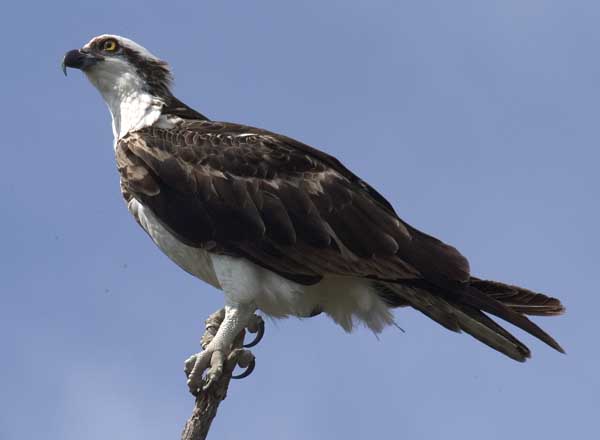
But an osprey can fly over and the loons hardly give it a second glance.
 
For those of you who have not seen one, an osprey is also a bird of prey.  It is often called a 'fish hawk' or 'fish eagle'.  It looks very much like a bald eagle only a little smaller.  But an osprey feeds almost exclusively on fish.  And therefore the eagle knows that it is not a threat.  
 
I have trouble distinguishin between a bald eagle and an osprey at a distance.  But the loon can do it easily.
 
So the loons will react strongly to the presence of a bald eagle and yet react almost not at all to an osprey.  How they can so quickly and easily distinguish between the two is yet one more of the mysteries and miracles of loons.  And they are not telling us how they do it.
 
But they clearly know what is a threat and what is not a threat to them.
 
One of the other things that you may want to watch for today are black flies that fly around the head of the loon.  They have already been around a few days and with the warmer weather today and tomorrow, I expect that we will see more of them.
 
The black flies are very small so it may be hard to even make them out on the video unless you look very closely.  Watch for head movements and the loon rubbing the head against its back as a sign there are black flies there.  Or occasionally the loon will 'snap' at things in the air that you may not even be able to see.
 
Maybe tomorrow I will say a few words about the black flies that torment loons.  That is yet one more amazing story in itself.
 
But so far today, the loons are enjoying a quiet and uneventful day.  And the rest of the day promises the same for our loons.
 
But for the loons, they know that things can change in an instant.
 
 
Questions or Comments?  LoonCam@yahoo.com

Monday, May 9, 2011 6:11am CDT


54 degrees   Heavy Rain  Wind  Calm


Lightning.  Thunder.  Heavy rain.


Like the proverbial water off a duck's back, she lets it roll.

Just another spring morning for the loon on the nest.

Fortunately so far there has been no severe wind or hail.  Rain she can deal with.  Hail and severe wind could be another matter if it comes.  Even the wind has to be pretty bad before she would leave the nest.

So while we are off doing other things, the loons are there.  Faithfully.  For 28 solid days.  Come what may.

The eggs are not something that can be forgotten only to come back to them later.  In whatever way they can, whatever goes through the 'mind' they have, they know they have no greater responsibility than to nurture and protect those eggs every minute of the day.

It is not a responsibility that they take lightly.

We still have at least one other pair of loons on the lake.  So that continues to produce the periodic confrontations and 'yodel matches'.  I have been told that this other pair of loons has actually nested, although I have not personally seen the nest.

The danger in a situation like this is that if the loons can see each other, the possibility exists that they both may be pulled off the nest for these confrontations.  And that puts the eggs at risk.

I hope that both nests -'our' nest and the other nest - are successful.  But the existence of another pair of loons nearby raises the risk.

I am pretty well convinced that is what happened last year and why the eggs did not hatch. 

Some of you will remember the incident on a very cold frosty morning the eggs were left exposed to the cold morning air and frost for about 40 minutes as both loons were lured across the lake to confront another pair of loons.  And apparently the exposure of the eggs to the cold for that long was enough to harm them and neither egg hatched.

We can only hope that something like that does not happen this year.  But it is a reminder once again of the fine edge between success and failure for nesting loons.

But for right now, let the lightning flash.  Let the thunder roll.  Let the rain come down.

Our loon sits ever faithful on her precious charge of two eggs!  Safe, warm and dry under her protective body.


Questions or Comments?   LoonCam@yahoo.com


May 8, 2011 6:21am CDT

 
49 degrees   Clear   Calm
 
 
On this beautiful Mother's Day morning, an expectant loon sits on the nest.
 
A huge red ball in the eastern sky.  Birds in full morning song.  A blue sky with a few white puffy marshmallow clouds.
 
The cool morning air of a Minnesota spring morning produces ever so faint wisps of fog which skid along the surface of the glassy water.  They will be here for just a short time.  As soon as the sun comes up above the trees, it will drive them away.
 
The loon is watchful.  Her head twists from side to side surveying everything that is going on around her.  Always watching and ready to respond to danger that may come from any direction at any minute.
 
This is the scene that will be the norm for the next 4 weeks.  The silhouette of a loon faithfully sitting on a nest on a northern lake.
 
With nicer weather finally here, it also means increased activity on lakes across the lakes in the northern US and on into Canada.  More boats.  More fishermen.  More activity in general.
 
It is a testament to how adaptive loons truly are.
 
Whereas the ideal for them probably would be a lake with no human activity, they are able and ready to adapt to lakes with a lot of human activity.  It just makes things harder for them at times.
 
So on this Mother's Day, our loon faithfully sits on two new eggs.
 
What is happening inside those eggs is something too wonderful to comprehend.
 
How actual life can spring from 'nothing'.
 
How in a few short weeks there can actually be little fluffy balls of black down that are able to move and live under their own power.  Sometimes the miracles are right around us and we miss seeing them in the busyness of our lives.
 
On this Mother's Day, take a moment to stop and look at the miracles all around you.  Think of your own mother.  Your kids.  Your family.  Your friends.
 
The miracle of life itself.
 
And be thankful for all that God has given you on this beautiful day.